tentative, subject to change and re-scheduling
| |
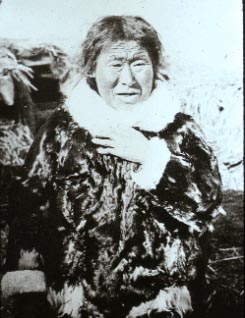
| Inuit Woman |
Review of the Course and Assignments, and the Ethnographic Perspective and Method (3 sessions)
Topics: Ethnography, research methodology and "Huckleberrying within the Tin Shed." Epistemologies and the stories we tell, examples from Scientific and Indigenous Ways of Knowing and Experiencing. How do we come to understand others and ourselves, and re-tell the stories? Issues of Cultural Property Rights, Collaboration, Application, Learning Style, Perspective, Epistemology, and Methods: symbols, orality and literacy, interpretation, text construction and evaluation. "Huckleberry" interpretative method and text construction (ol) (ol) (Burnt Face)
Readings: Frey Bash Baaaliíchiwé pp. 3-27 (Huckleberrying), 74-122 (on an ethnographic methodology for engaging, interpreting, writing, evaluating and teaching Indigenous story texts, doing ethnography humanities style); Huckleberrying Method
Case Study Readings: depending on which two ethnographic texts you have selected, get started, applying the Huckleberrying interpretative method to your reading.
Email your selection of your two case studies to rfrey@uidaho.edu by Thursday September 1, 4:00 pm.
Video Option: Wade Davis: Dreams from Endangered Cultures (from TED Talk 22:05; filmed Feb 2003) On Different Ways of Being
Dates: August 23, 25 and 30
A Question of Origin and Place - Scientific Knowing and the Story of Evolution (3 sessions)
Topics: the scientific method, biological evolution, the fossil record, "race," nature and nurture. As a species, what is our origins, and, as individuals, are we what we are taught or what we are born with? Our origin and place as subscribed by the "evolutionary" story of it. Lecture Outline
Readings: Frey
pp. 139-150 (on Head Knowledge and the Scientific Method), Lactase
and Natural
Selection (the mechanism of evolution, The Dream
Animal (the story of evolution), and
Persistent
Hunter. You will need an Adobe Reader to access PDF
printable files

Case Study Readings: continue your two ethnographies
Video Options: Bones of Turkana (60 min., this 2012 film follows the paleoanthropologist Richard Leaky as he and is colleagues unravel the mysteries of human evolution.) and Lucy and the First Family (58 min., In 1974 in Ethiopia, Donald Johanson and Tom Gray unearthed an early hominid bipedal, Australopithecus afarensis, whom they named, "Lucy," dating over 3 million years old. These films are a nice introduction to evolutionary theory and the application of the scientific method and evidence.)
Supplemental Materials: Scientific Method (and seven embedded short vignettes), image of Pythagoras, Ptolemy and Copernicus, Galileo, Bacon, Locke, Descartes, and Newton; the Smithsonian Institution's Human Origins Program; Images of Lucy; Upper Paleolithic Cave Art; the American Anthropological Association's Statement on "Race" and Statement on "Race" and Intelligence
Dates: September 1, 6 and 8
First Exam and Study Session
Dates: September 13 Review and 15 Exam
A Question of Origin and Place - Indigenous Knowing and Aesthetic, and the Stories of Creation and Ceremony (5 - 6 sessions)
Topics: orality and literacy; ritual and ceremonialism; oral literature and creation narratives; and art. How have people related to the transcendent and spiritual worlds, what is "creation," what is "beauty," and who is "God"? Our origin and place as subscribed by our "creation" story of it. Story brought forth into Ceremony and example of the Sundance. The Wheel and Mutual Exclusivity Lecture Outline Lecture Outline
Readings: Frey pp. 28-73 (on Stories, Orality and Storytelling), pp. 23-25 (Prayer for a son), 123-138 (on Sundancing), pp.139-184 (on Heart Knowledge and Sqigwts), pp. 19-22, 201-222 (on addressing the "mutually exclusive" in our personal and public lives); Sedna and Inuit Art and Ritual, Balinese Time and Balinese Arts, Navajo Words and Images, and optional: Typology of Rituals, Australian Aboriginal Dreamtime and Aboriginal Ceremony,
Case Study Readings: continue reading and interpreting your two ethnographies.
Video Options: Three Worlds of Bali (59 min., 1980 Odyssey Series PBS; Notes on Bali) and The Living Stone (32 min., 1958 National Film Board of Canada). These two classic films nicely illustrate Indigenous epistemology. Billy Yellow (18 min., on Navajo healing ceremony; notes on Billy Yellow), Huichol Healing (17 min.), Balinese Wayang Shadow Puppets (8 min., clip from Three Worlds of Bali), Crow Sundance (22 min., a 1989 recording of key segments of the Dance), and Trance and Dance in Bali (21 min., filmed by Margaret Mead [1901-1978] and Gregory Bateson in the 1930s, released in 1952. In 1999 this film was deemed "culturally significant" by the United States Library of Congress and selected for preservation in the National Film Registry.) Kurtal: Snake Dance (27 min., this 2001 film follows the journey of Spider, an 80 year old Aboriginal elder into the ritual and reality of the Snake Spirit). Australia Dreamtime (26 min., this 2005 film describes the life and sacred aspects of the Anangu and Tiwi and their Dreamtime.) A Curing Ceremony and N/um Tchai: Medicine Dance (8 min. and 20 min., these two short films by John Marshall illustrate key elements of !Kung San ceremonial life). Many of the following video clips are from David Maybury-Lewis' Millennium: Tribal Wisdom and the Modern World series (PBS 1992). Maybury-Lewis was a former professor of anthropology from Harvard University.
Supplemental Materials: Sqigwts, Iroquois False Faces, Crow Sundance, The Caves, Dogon Seed, Indigenous Art, and Euro-American Transformations, Plato's Cave, Humanity Mirrors the Cosmos; Faces of the Indigenous; in the News: Australia Apologizes to Aborigines
Dates: September 20, 22, 27, 29, October 4
The Life Cycle, Rites of Passage and Pilgrimage (3 sessions)
Topics: initiation rites and the "individual." What is the process by which the "individual" is integrated within the larger fabric of his or her society and ecology? What is a "healthy person"? How are our self identities formed? Lecture Outline and
Readings: Frey pp: 201-216 (review a Healing Journey); Rites of Passage, Rites/Pilgrimage Diagram and Pilgrimage Outline Begin Immediately.
Case Study Readings: continue reading and interpreting your two ethnographies. Based upon your case studies, have you begun to identify your paper topics?
Video Options: A Rite of Passage (14 min., on a !Kung San boy's first hunt and the ritual of "marking" and its meaning that follow). Xavante Age Sets (15 min., notes on Xavante Age Sets), Weyewa Identity (17 min., notes on Weyewa Identity), Dogon Death (15 min.), Huichol Pilgrimage (33 min., notes on Huichol Pilgrimage) are part of the Millennium series. Inside Mecca (56 min., on the Muslim Hajj, Discovery Channel, April 2006) or Hajj (Nightline 2006, 22 min., on Google Video). Also consider the funeral ceremony of the Dani in Dead Birds and a girl's coming of age ceremony in Seasons of a Navajo (below). Kinaalda: A Navajo Rite of Passage (56 min. Film allows viewers access to one of the oldest and most sacred of all Navajo ceremonies. It also illustrates the complexity of living in two worlds. Film by Lena Carr)
Supplemental Materials: Aboriginal Rites of Passage, American Individualism
Dates: October 6, 11 and 13 Oct 10 Indigenous Peoples Day
The Ecological Fabric (4 sessions)
Topics: gatherer/hunter and the "Original Affluent Society," the objectification of the landscape, domestication and horticultural, agriculture and "civilization," industrial and informational societies, the "culture of consumption," and environmental stasis. What are the various ways peoples have defined and related to the natural world and their "landscape"? Why did we domesticate plants and animals, and what are the implications of doing so? Why do some cultures seek mightily to live within their landscape as a part of it, while others, with equal commitment, attempt to live apart from it, controlling and dominating it? What is a "healthy environment"? Lecture Outline Presentation
Readings: Coeur d'Alene Ecology, Original Affluent Society, and Jericho: Domestication and Walls, Fertile Crescent
Case Study Readings: continue your two ethnographies.
Video Options: N!ai's Life (39 min., John Marshall's 1952 account of this !Kung Bushman gatherer-hunter way of life prior to being placed on a reservation in 1978, as recounted by !Nai herself, with additional footage and commentary by Marshall; footage from both 1952 and 1978) or The !Kung San: Traditional Life (26 min., This John Marshall 1987 video depicts traditional Ju/'hoan life by using vignettes from longer films in the !Kung San series. Footage selected shows tool-making technology, hunting and gathering, social life and children at play, and gives the viewer a feel for the vastness and beauty of the Nyae Nyae region of the Kalahari Desert). Makuna Consent (23 min., notes on Makuna Consent) and Gabra Finn (15 min., notes on Gabra Finn) are part of the Millennium series. Seasons of a Navajo (58 min., a 1984 view of the seasonal round of a Navajo family, including as segment on the Kinaalda, girls puberty rite of passage; an excellent depiction of family life; PBS). Nanook of the North (79 min., the Robert Flaherty 1920 classic of one family's seasonal round as hunters and fishermen in the frozen desert, commentary by Flaherty). The Nuer (73 min., this 1971 Robert Gardner classic depiction of the Nuer of Ethiopia and their cattle-herding way of life) and Dead Birds (83 min., the 1964 Robert Gardner classic account of village life among the Dani of West Papua, New guinea; excellent depiction of horticultural subsistence; see below)
Supplemental Materials: Aboriginal Ecology, Schitsu'umsh Landscape, Horticultural Ecology, Herding Ecology, Farming Ecology, Industrial Ecology, Capitalism, Culture of Consumption and Bateson's "Mind"
Evening Session at the Movies: - Atanarjuat - The Fast Runner (2002) Day: TBA, Time: 6:00 pm, Room: TBA
Dates: October 18, 20, 25 and 27
Second Exam
Date: November 1
Proposals for the two Participatory-Interpretative Papers Due by 5:00 pm. Can drop off at the office or email as two attachments or in body of text. Late submissions will lose points.
Date: November 7
The Social Fabric (4 sessions)
Topics: family, marriage, kinship, gender, leadership, power, "individualism," and the objectification of the species. Why are we such a gregarious species, with a tremendous capacity for "love" and compassion, yet with equal passion also able to "hate" other humans? Why are we the only species that can systematically kill and go to war with its own kind? Why are there so many differing ways to define and relate to other humans? Why do some individuals have greater "power" over others and more access to the "goodies"? What defines "family"? What defines a "rich person"? Lecture Outline
Readings: Descent Systems, Crow Matrilineal "Crow" Kinship, Coeur d'Alene "Hawaiian" Kinship, Bilateral Cross-Cousin Marriage, Loves (based on Lewis), and American Individualism
Case Study Readings: continue your two ethnographies
Video Options: Gifts (3 min., considers the power of gift giving), Weyewa Stone (21 min., notes on Weyewa Stone), Gabra Stranger (13 min., notes on Gabra Strange), Wodaabe Love (17 min., notes on Wodaabe Love), Nyinba Brothers (19 min., notes on Nyinba Brothers), Beatrice (13 min., followers the life of a Navajo woman), Wodaabe Beauty (18 min.), Maasi Women (60 min., follow the life of this east African cattle herding people through the eyes of its women) are all part of the Millennium series. Dadi's Family (60 min., follow the life of a large extended family in Northern India, 1980). Also consider the kinship and family relations illustrated in Seasons of a Navajo (above)
Supplemental Materials: Marriage and Roles of Women
Dates: November 3, 8, 10 and 15
Review Paper
Optional. If you would like the instructor to review and comment on one of your two papers (not grading it at this time), before submitting the final versions of the papers, you can turn one of them immediately following Fall Recess. You should get the "review paper" back with comments within a few days.
Date: November 29
|
|
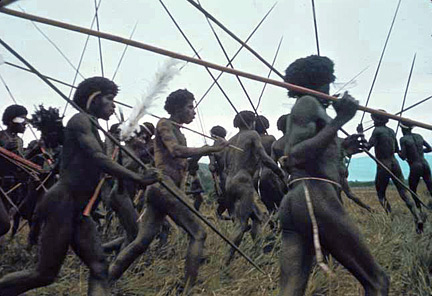
| from Dead Birds |
The Dynamic Fabric (4 sessions)
Topics: innovation, diffusion, assimilation, genocide, modernity and traditionalism, technological change, and war. How do societies change? Why do we war against ourselves? What is the nature of innovation and discovery? Are we the masters of our own fate or pawns of society? How have peoples initiated and/or responded to continuity and change through time? Lecture Outline
Readings: Frey pp. 185-200 (on Traditionalism) and Sqigwts; Change Model, Theories of War, Bateson's Schismogenesis, Kroeber's Style Pattern, Greek Style Pattern, Kuhn's Paradigm Shifts and Inclusivity
Case Study Readings: continue your two ethnographies
Video Options: N!ai's Reservation (33 min., continuation of John Marshall's 1978 film on the !Kung, San showing the impact of a cash economy, schools, missionaries and recruitment into the South African army. In 1978 the South African government established a reservation on the Namibia/Botswana border which restricted the !Kung San to an area one-half the size of their original territory. The reservation lacks sufficient food and water for the !Kung to continue their gatherer-hunter life.) or The !Kung San: Resettlement (28 min., In comparison to The !Kung San: Traditional Life, this 1988 video shows some of the dramatic changes in life-style that Ju/'hoansi had experienced by 1986. No longer able to rely on hunting and gathering for subsistence, Ju/'hoansi collect mealie meal welfare, spend money earned from army jobs on alcohol and consumer goods, and live in a crowded area with increased fighting and illness. With a move back to traditional lands and development of cattle herding and subsistence agriculture, there is hope that Ju/'hoansi can be successful in a mixed economy). Dead Birds (83 min., Robert Gardner's 1964 classic account of Dani life and the nature of warfare that underpins this society)
Supplemental Materials: Genius, Touched, Fish and Submarines, Pasteur, Hawaiian Religion, Flying Machines, Wallace and Darwin, Flag, Light, and Domestication
Evening Session at the Movies: Dead Birds Day: TBA, Time: 6:00 pm, Room: TBA
Dates: November 17, 29, December 1 and 6
Review Session
Date: December 8
Participatory-Interpretative Projects (two) Due
Date: December 9 (Friday) by 4:00 pm
Final Exam
Date: December 12 (Monday) at 10:00 to 12:00
[Return to top]
You are currently viewing http://www.webpages.uidaho.edu/~rfrey/220sch.htm
To return to the University of Idaho Home Page
Page manager: rfrey@uidaho.edu