Plateau Indians
ANTH 422/522, AIST 422, RELS 422 - Fall 2017
Overview and Study Questions
The materials on this page are intended for use by students enrolled in
ANTH 422/522 Plateau Indians. This page and its references are periodically up-dated.
Organize study sessions in a manner to that all family members gain a
competency in
these learning activity. All individual family members are held
accountable and are expected to be competent in his or her responses to all
study guide questions. At the "in the round recitation" session, separate questions from
this study guide will be asked of each individual family member, and he or she
will be expected to respond to the question posed with competency. At the
conclusion of the each family member's particular response to a question, other
family members may join into the conversation and supplement the initial
response. In
your responses, consider not only what you convey, i.e., response content, but how
you go about conveying it, i.e., the delivery style and technique. Not all
study guide questions will be incorporated into the recitation session.
The entire recitation could last up to two hours. The evaluation will be based on upon both
individual family member response competencies, as well as competencies
demonstrated from the family in support of and supplemental to individual
responses. The evaluative focus is thus on a "group family
grade." But the instructor does reserve the right to offer differentiated grades, if a
student does not contribute or does not meet
expectations, for example.
-
First
"In the Round" Recitation Dates: TBS after
completion of sections A. "Methodology" and B. "Winds of Change." To be held following
class or at a time convenient for all participants (chatq’ele’, waĺáwa, lé·pwey and q’emiln
families). Should take approximately 90 minutes.
-
Final
"In the Round" Recitation Dates: on all of
section C. "The World of the Nimíipuu (Nez Perce) and Schitsu’umsh
(Coeur d’Alene) - (Indigenous - Animal Peoples Riverbed)," with the
recitations beginning Friday
December 8th and running until Friday December 15th. To be held following class or at a time
convenient for all participants (chatq’ele’, waĺáwa, lé·pwey and q’emiln
families). Should take no longer than 90 minutes.
Grading
criteria:
-
seek to convey
an indigenous perspective and understanding of the questions posed.
-
accurately
and authentically presents the material requested in the questions.
-
completely
covers the breadth of issues posed in the questions, as well as their
implications.
-
refers to and
integrates appropriate case examples from the textbooks, lectures,
field trip speakers to illustrate concepts.
-
makes ethnographic connections with other tribes or related
cultural expressions.
-
reflects on the implications
of the issues posed in the questions as they relate to the student's
own experiences.
-
spoken
in a legible and well-organize style with concepts and illustrative
examples clearly articulated.
-
clearly
indicates that each family member has made a meaningful contribution
to the success of the whole family.
 |
|
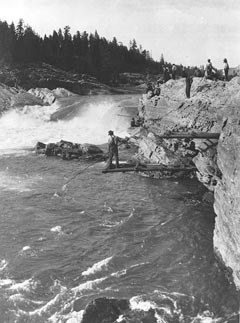
Salmon Fishing at Kettle Falls - ca. 1930s
|
Overview
The Plateau culture area extends from the Cascade Mountains of Washington and British
Columbia in the west to the Rocky Mountains of Montana in the east, encompassing the
entirety of the Columbia River basin. The Fraser River valley of British Columbia marks
the northern boundary, while the Columbia and Salmon Rivers of Oregon and Idaho mark the
southern reaches of the Plateau.
In the example of Coeur d'Alene we have a wonderful illustration of how the oral
traditions have helped mold the customs and lives of a particular tribe. After a brief
consideration of pre-contact Coeur d'Alene society and of the historical changes brought
by contact with Euro-American society, this lesson will focus on the continuity and
continued importance of such cultural expressions as the "First Peoples," root
gathering and deer hunting, traditional land tenure practices, the powwow, the ceremonies
of the Sweat House and Jump Dance, and the Memorial Give Away. Like other Plateau peoples,
the Coeur d'Alene lived a semi-nomadic, transhumance pattern, moving with the
seasonal-round to specific localities within their home territory for salmon fishing or
trading with other tribes, root digging, berry gathering, deer hunting, and finally winter
encampment. They lived in a fundamentally equalitarian society, with relatively little
warfare between tribes. Spiritual guidance was gained in vision questing.
Study Guide Questions, focusing primarily on the
Schitsu'umsh - Coeur d'Alene
and the Niimíipuu - Nez Perce. Additional questions
could be added.
For the first In-the-Round:
- How would you characterize the particular approach/methodology taken in
this course and articulated in Landscape Traveled by Coyote and Crane (2001)
and in the Carry Forth the Stories
(2017) in pursuit of the goal of understanding and appreciating Plateau Indians?
What are the key
elements and components of "Huckleberrying and Tin Shedding," for researching (gathering
information as well as interpreting it), for teaching, and for writing? What are some of the implications for the student-participant in pursuit of
this goals? Consider advantages and disadvantages of this approach.
- Identify the approximate aboriginal territory of the Coeur d'Alene and the
Nez Perce. Identify the
traditional locations of ten (10) Plateau Peoples, along with their
linguistic affiliations and key geographic associations (nearby
rivers, mountains, etc.). Be able to draw a map of the Plateau
from scratch.
- Overview of Tribal Sovereignty:
Plenary Powers vs. Self-Determination - Define Tribal sovereignty, and in what ways is it
compromised by the United States government?
- How was intertribal conflict often resolved prior to European contact?
- Outline the traditional seasonal-round of the Coeur d'Alene, Nez Perce and
mid-Columbia Peoples.
- What were fishing techniques and technologies were used by the Nez Perce
and mid-Columbia Peoples?
- What was the nature of pre-contact Coeur d'Alene social organization (the band) and
political power (the chief)?
- What role did the shaman play in pre-contact Coeur d'Alene society?
- Identify and discuss the prevailing Euro-American cultural values of the
contact era.
- Identify and discuss the types and forms of contact pluralism and
assimilation.
- Discuss "traditionalism," and provide examples.
- Develop an outline identifying how each of the following Euro-American influences
effected Coeur d'Alene and Nez Perce cultures: the horse, diseases such as smallpox, the fur trade, the
Jesuits and Presbyterians , military engagement with the United States,
Treaties, Executive Orders and the Allotment
Act, and mining.
- Discuss smallpox and other
infection diseases - what were the effects of these epidemics on
Indian society?
- Discuss Lewis and Clark, and the Fur Trader - what were the consequences of this early contact?
- Discuss the Missionaries: Circling Raven,
1831, St. Louis and the Catholics; Spalding,
Whitman and Presbyterians; 1842, the "Black Robes" and the
Cataldo Mission - What was the appeal of the missionaries, and the
particular appeal of the Jesuits? Contrast the missionary
motivation to establish a "wilderness kingdom" among the
Indian with the general goals of the emerging Euro-American society
toward the Indian. What is the lasting legacy of the
missionary experience?
- Discuss the Yakama War of 1855,
the Steptoe War of 1858, and the Nez Perce Conflict of 1877 - What were
the consequences of these wars?
- Discuss Treaties, Executive Orders, and the
Dawes Act
- What were the motivations of the United State government to enter
into treaty relations with the tribes? What were the
consequences of all these enactments?
- Discuss the Indian Reorganization Act
of 1934 and the Self Determination Act of 1975- How did these acts
effect tribal society, both positives and negatives? Consider
the role and implications of "Blood Quantum Laws."
- Discuss the Challenges and Growth of Tribal sovereignty:
The examples of Salmon and fishing rights, Gaming, and the
"Wounded."
- Who was Smohalla, and what were the central doctrines of the Dreamers?
- Identify the principle contemporary expressions of Coeur d'Alene and Nez
Perce self-determination and
the ways the tribes are attempting to re-establishing its sovereignty.
For the second In-the-Round:
- Know the particular oral traditions of your own family (lé·pwey, waĺáwa, q’emiln,
chatq’ele’, and s'maq'l) and integrate them into your responses to the questions
listed below.
- Discuss the meaning, structure and dynamic, and the implications of
hnkhwelkhwlnet and
tamálwit. What are the primary ontological principles
upon which the Indigenous world of the Plateau Peoples is based and
created? What is Heart Knowledge? And how is reality
experienced? How does this world and reality differ from the world
built upon Head Knowledge? Illustrate your
responses with specific examples.
- Who is the Amotqn and what are the Titwatityáaya?
- Contrast the character of Coyote with that of Crane and Chief Child of the Yellow Root.
How are they similar and how are they different?
- What are the five fundamental miyp - "teachings" of the Coeur d'Alene?
Based upon the specific story narratives offered in Landscape Traveled
by Coyote and Crane: The World of the Coeur d'Alene
Indians, provide references from those stories that illustrate each of the five
"teachings."
- Why do the elders continue telling the oral traditions? What are
their importance?
-
What is the fundamental nature, and the role and key responsibilities
of the Human Peoples?
-
How does the act of storytelling help facilitate this critical
Human responsibility? What are the responsibilities of the
storyteller and of the audience?
-
What are the components
and dimensions associated with storytelling techniques,
orality, and the power of the spoken word? Discuss each in
detail, and how they coalesce with each other.
-
How does Sqigwts.org help demonstrate the
importance of aligning the "how" with the "what"
(and discuss the nature of the "how" and the "what")?
-
What is the nature and role of
snukwnkhwtskhwts'mi'ls in the stories?
-
What is meant by "keeping
the bones of the story together"? And what
are the implications of that act for other human
actions?
-
And thus by extension, what
results from the acts of re-telling the perennial
stories, of re-singing the
súumesh
songs, of re-dancing the spirit dances?
-
How does this all work?
Its efficacy?
- Discuss the traditional seasonal round of
your family, from winter to spring through summer, into fall and back to
winter. For each of these seasons provide discussion on, which
members of your family would be involved and doing what activities, what
primary foods would your family be seeking and which technologies would
they be using and associated with, and what ceremonial and culturally
expressive activities would be conducted?
- What are camas and water potato, and what role do they play in Coeur d'Alene culture
today?
- How would you characterize a family's relationship with their "home
territory?"
- What are the primary structures, qualities
and roles of the family, providing illustrative examples for your
discussion?
- Outline the general features and procedures you might experience at a Coeur d'Alene
or Nez Perce powwow. What is the meaning often associated with the songs and dance associated with the powwow?
- Define the concepts of Súumesh or Wéyekin. Of what significance do they
play in contemporary Coeur d'Alene and Nez Perce? How it is acquired"
In what ways is it applied? How does it work - reflecting on its
efficacy?
-
What are the roles and functions of the Sweat House, Jump
Dance, Healing Ceremonies and Funeral and Memorial Give Away?
Consider Frey's healing journey with cancer. Consider
the Ashkísshe
and what transpires within.
-
What are the components of the
Wake/Burial and Memorial Give Away?
-
What are the components of the
Sweat House and Jump Dance ceremonies?
- What is the meaning of the phrase, "then, the end of the trail," traditionally
heard at the conclusion of the telling of a story? What are the implications of this
phrase for the meaning and role of the oral traditions?
- Discuss the role of sharing in plant and animal rituals, offering examples to illustrate
your discussion.
- Outline the general features and procedures you might experience at a Coeur d'Alene powwow. What is the meaning often associated with the songs and dance associated with the powwow?
- What are the purposes of the Sweat House Ceremony?
- What are the purposes of the Jump Dance Ceremony, and what does it mean to Blue Jay?
- What are the purposes of the Memorial Give Away, and what is the meaning in the phrase,
the deceased go on ahead of us to have a big tipi camp ready for us?
- When a Coeur d'Alene speaks of "home," what might the concept mean?
- What is snukwnkhwtskhwts'mi'ls and what is it significance?
- What were you're most important "huckleberries"
you gathered this semester? As discussed in class, what are the
desired big "take-aways"?
Return to Top
You are currently viewing
http://www.webpages.uidaho.edu/~rfrey/422plateau2.htm
To return to the ANTH 422/522 Syllabus
To return to Frey's Home Page
To return to the University of Idaho Home Page
Page manager: rfrey@uidaho.edu
