 Welcome to our course entitled, North American Indians. I am your instructor, Rodney Frey.
Welcome to our course entitled, North American Indians. I am your instructor, Rodney Frey.
Contact me at:
Voice: 885-6268
E-mail: rfrey@uidaho.edu
Home Page: www.webpages.uidaho.edu/~rfrey
Office Hours: Monday and Wednesday 9:00 to noon and by appointment.
Office: Phinney Hall, Room 116
Class Days/Times and Location:
Class Schedule: Tuesday and Thursday 9:30 - 10:45
Education Building 442
NOTE - See Family Membership. As the course seeks to include an Indigenous pedagogy, you will need to adjust your schedule to meet with family members on a regular weekly basis, times outside of the scheduled class day/times. Also, optional day-long field trips will scheduled.
Our textbooks include:
Rodney Frey. Carry Forth the Stories: An Ethnographer's Journey into Native Oral Tradition. Washington University Press 2017. (ISBN 978-0-87422-348-4)
Wendell Oswalt. This Land Was Theirs: A Study of Native North Americans. Oxford University Press 2006 or 2009. 8th edition (ISBN 0-19-517810-6) or 9th edition (ISBN 978-0195367409) (three copies on Library 3-hour reserve)
Numerous PDF and HTML texts. See schedule
Course Learning Outcomes (course learning outcomes, linked with departmental and university learning outcomes)
Course Learning Activities (exams, paper, storytelling, attendance, grading points)
Course Schedule (topics, assignments, session and other important dates)
Membership of family groupings.
The following pages offer links to the primary Study Guides and to additional Study Guide Questions, which includes reading assignments, and Resources and Supplemental Materials, which includes links to other pages on the web, samples of music, and bibliographic information.
Primary Exam Study Guides for ANTH 329: One, Two, Three, Four
Overview: Study Guide and Supplemental (also includes bibliographic information on the Sub-Arctic, Southeastern, California and Great Basin culture areas)
Non-Indian Relations: Study Guide and Supplemental on Boarding School History
Narrative Oral Traditions: Study Guide
Arctic: Study Guide and Supplemental
Plateau: Study Guide and Supplemental
Plains: Study Guide and Supplemental
Northwest Coastal: Study Guide and Supplemental
Southwest - Navajo: Study Guide and Supplemental
Southwest - Pueblo: Study Guide and Supplemental
Eastern Woodlands: Study Guide and Supplemental
To access music at these sites, you will have to download a free RealPlayer
 Course Description: There have perhaps been no people more
misunderstood nor more misrepresented than the American Indian. Stereotypes abound, from
being labeled "primitive heathens" to that of "noble savages."
While
history has witnessed the considerable cultural assimilation and physical genocide of the
Indian, today we observe a vibrant culture, persisting and flowering into the twenty-first
century. The overriding question asked throughout this course is who, in fact,
are the Indian peoples of this land?
Course Description: There have perhaps been no people more
misunderstood nor more misrepresented than the American Indian. Stereotypes abound, from
being labeled "primitive heathens" to that of "noble savages."
While
history has witnessed the considerable cultural assimilation and physical genocide of the
Indian, today we observe a vibrant culture, persisting and flowering into the twenty-first
century. The overriding question asked throughout this course is who, in fact,
are the Indian peoples of this land?
If our ultimate intent is to gain a better appreciation of the rich and dynamic culture of the Indian, it is critical we approach the world of the Indian, as best we can, from the perspective of the Indian, devoid of bias and preconceived ideas. Critical to our goal will be the presentation of a methodology that can convey, with integrity and authenticity, the voice and heart of the Indian. There is thus an acknowledged relationship between what is taught (Indian culture) and how it is taught (teaching methods). Certainly, a vast and well-developed inventory of anthropological and historical approaches can contribute to this endeavor. But we shall use these approaches sparingly. We also must acknowledge the constraints imposed on the "how" given the delivery format for this course, e.g., "textbooks," "classrooms," and "lectures." But in acknowledging the impact of such constraints we have taken the first steps in compensating for them.
Our focus is on an appreciation of the "traditions" that have anchored Indian identity and have continued to find expression throughout history and into the contemporary world. The approach taken in this course, the "how," is thus simply but with great effort and sensitivity to appreciate and incorporate, as best we can, an Indian epistemology. We must ask ourselves, "how would an Indian elder come to know the world, and, in turn, convey his story to his own grandchildren or share it with us?"
|
|
|
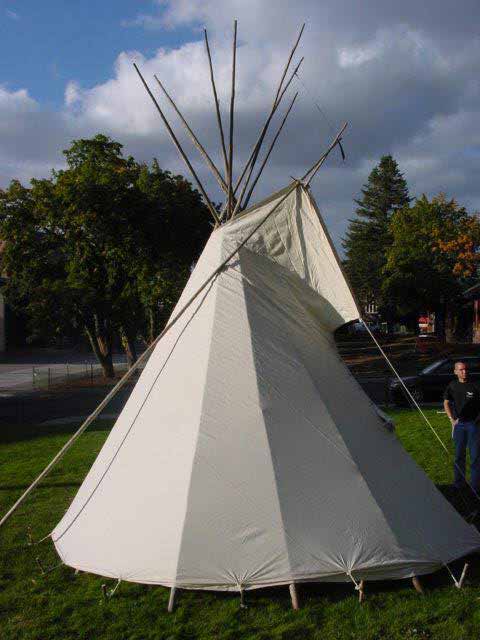
Crow Lodge on the U of I campus, October of 2000 (open tipi for slide show) |
As our approach is anchored in the world of the "First Peoples," such as Coyote and Changing Woman, our journey begins with an appreciation of the oral traditions. It is from the First Peoples that the world was first created and all that would be needed for Human Peoples to thrive brought forth. From the First Peoples the various ways to relate to the Spirit, Animal and Human Peoples were instituted, in prayer and song, and through the Sweat House or Give Away, for example. In continuing to tell of the First Peoples these ways of relating and the world itself are perpetuated. In turn, it is with the oral traditions that an elder would seek to teach and pass on to a grandchild that which is most vital to the Indian, or even attempt to educate a stranger to the Indian ways. Through the "stories" and "storytelling" we can better understand the voice and heart of the Indian, their most cherished "teachings," their cultural values. From a foundation built upon the oral traditions, we can then explore aesthetic expressions, rites of passage, health and healing practices, ceremonial life, family and kinship, social and political organizations, and ecological relationships. It is an approach to appreciating the world of the Indian, the "what," that attempts to more closely parallel an Indian ontology.
To better appreciate the vitality and continuity of the world of the First Peoples, the historic world of Euro-American contact with Indians peoples must be reviewed. Among the topics considered will be the impact the horse, diseases, missionaries, war and treaties had and continue to have on Indian society. To fully begin to appreciate the policies and process emanating out of Euro-American contact history with the Indian, the emerging cultural values of this new societal experiment will also be considered. Paramount in our discussion of the confluence of American Indian and Euro-American cultural values and its varied manifestations will be an appreciation of the meanings of contemporary "tribal sovereignty."
Given the tremendous diversity and richness of the indigenous cultures of North America, special emphasis will be given to the Crow of the Plains, the Netsilik of the Arctic, the Navajo and Hopi of Southwest, the Kwakiutl of the Northwest Coast, and the Coeur d'Alene, Kootenai and Nez Perce of the Plateau. In addition, many of the contemporary issues facing Indian nations, such as those relating to sovereignty, religious freedom, education, health and natural resources, will be more fully addressed in the seminar, AIST 401 - Contemporary American Indian Issues.
You are currently viewing http://www.webpages.uidaho.edu/~rfrey/329.html
Page manager: rfrey@uidaho.edu